
West Haven Court Records After Arrest
For West Haven court records after a jail arrest, the first correction is venue. Adult local criminal and motor vehicle cases from West Haven do not default to the New Haven Judicial District just because a person may be held at New Haven Correctional Center. The Division of Criminal Justice's Ansonia/Milford page states that the district serves West Haven and that G.A. No. 22 in Milford handles class C, D, and E felonies, misdemeanors, infractions, and motor vehicle matters occurring in Milford and West Haven. More serious Part A matters route through the Ansonia/Milford Judicial District State's Attorney office.
The custody path and the court path can split. WHPD may arrest and process a person. CT DOC may hold the person if bail is not made or a court order commits the person to custody. The Judicial Branch court record tracks filed charges, docket events, bond orders, warrants, and dispositions. For custody and booking details, use West Haven jail inmate records. For booking photos, use West Haven jail roster mugshots. Court records after arrest answer a different question: what charges were filed and what happened in court.
West Haven Arrest Court Routing
The local court address that often matters for West Haven is Milford, not New Haven. G.A. No. 22, Milford is at 14 West River Street, Milford, CT 06460. The G.A. prosecutor phone listed in research is (203) 874-3017. Serious Part A matters also use 14 West River Street through the Ansonia/Milford Judicial District State's Attorney, phone (203) 874-3361. Juvenile delinquency matters are different and may route through New Haven Juvenile Matters, with public access restricted by juvenile and youthful-offender rules.
That routing affects search choices. In the Judicial Branch lookup tools, choose Milford Geographical Area 22 for many adult local West Haven criminal and motor vehicle matters. Use Milford Judicial District when the case is in the judicial district path. If the person is housed at New Haven CC, do not assume the court location is New Haven. Custody location and court location are two separate fields in the workflow.
Milford G.A. No. 22
14 West River Street
Milford, CT 06460
(203) 874-3017
Class C/D/E felonies, misdemeanors, infractions, and motor vehicle matters from West Haven.
Ansonia/Milford State's Attorney
14 West River Street
Milford, CT 06460
(203) 874-3361
More serious Part A matters in the judicial district.
Search Court Records After Arrest
The Connecticut Judicial Branch criminal and motor vehicle case lookup hub separates pending cases, daily dockets, convictions, and attorney lookups. Pending case search is the best starting point when the case is active and the defendant's name or docket number is known. A case may appear even if the person is no longer in custody, because a release on promise to appear, bond, or nonfinancial conditions does not erase the court record.
Use the pending defendant search with the West Haven routing in mind. The court location field can narrow results to Milford Geographical Area 22 or Milford Judicial District. A broad statewide search can help when the person was arrested elsewhere, transferred, or has more than one case.
| Field Label | Type | Required | Options / Format Notes |
|---|---|---|---|
| Last Name (begins with) | Text | Yes | Maximum length 60. |
| First Initial | Text | No | Maximum length 1. |
| Birth Year | Text | No | Maximum length 4. |
| Year Range + or - | Text | No | Maximum length 1. |
| Court Location | Dropdown | No | Includes Milford Geographical Area 22 and Milford Judicial District. |
| CategoryType | Dropdown | No | Blank, Criminal, Motor Vehicle, or license/registration suspension referral. |
West Haven Pending Case Screen
The public Pending Criminal/Motor Vehicle Case Search by Defendant is the fielded search form used to check active court records after a West Haven arrest.
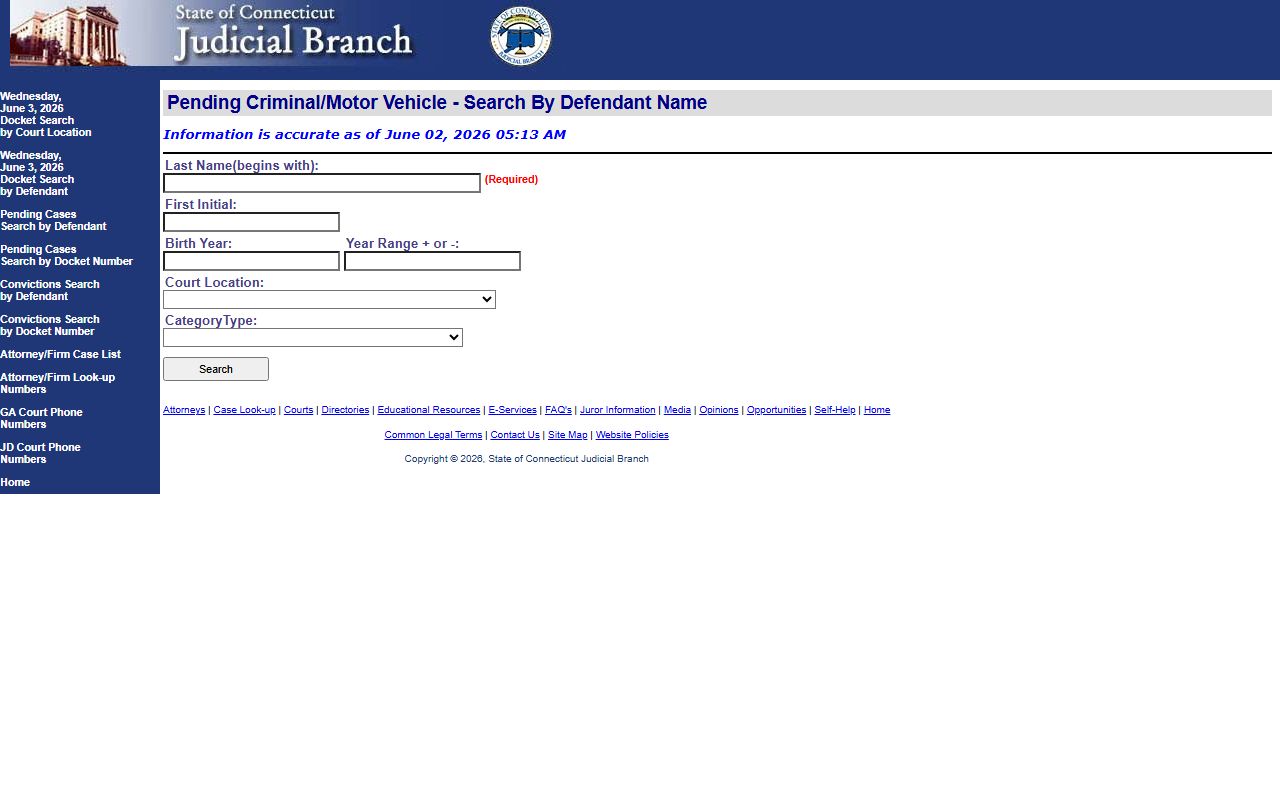
The court-location dropdown is important because West Haven local adult cases commonly point toward Milford GA 22 or the Ansonia/Milford Judicial District.
West Haven Court Dockets
Docket-number search is best when the user already has a docket from a bond receipt, court notice, attorney, police paperwork, or prior lookup. For West Haven, the research identifies A22M as Milford GA 22 and AAN as the Milford Judicial District. The daily docket search is different. It shows scheduled appearances by court for the date shown, but Judicial Branch notes that daily dockets do not include add-on dockets. A same-day custody matter can be missing if it was added late.
| Docket Search Field | Type | West Haven Note |
|---|---|---|
| GA/JD | Dropdown | A22M for Milford GA 22; AAN for Milford Judicial District. |
| Type | Dropdown | CR, MV, CI, or MI depending on case type. |
| Year | Text | Two-digit docket year. |
| Number | Text | Maximum length 7. |
| Suffix | Dropdown | S, T, A, or number suffix options. |
The daily criminal/motor vehicle docket search by court uses a court-location dropdown. Choose Milford Geographical Area 22 for local West Haven GA matters, then confirm details with the court if the case is time-sensitive.
Arrest to Court Record
The arrest to court pathway starts with police processing and ends with a court disposition or continuing case status. WHPD creates the local arrest report. Police, Pretrial Services, or a judge may set release conditions. The prosecutor then reviews police reports and decides what charges to file or pursue. A booking or DOC entry may show an arrest or controlling offense, while the Judicial Branch case record shows charges filed in court, amendments, disposition, and scheduled events.
Arrest charges can change. A prosecutor may decline one count, amend a charge, add a substituted information, or route a serious matter to Part A. Court records after a jail arrest should therefore be read as the active legal record, not as a copy of the police booking screen.
- WHPD or another agency arrests and processes the person.
- Release, bail, or hold status is reviewed by police, Pretrial Services, court, or DOC.
- The prosecutor reviews the arrest materials and files, changes, or declines charges.
- The Judicial Branch case record lists pending charges, docket dates, orders, and dispositions.
- Sealed, erased, juvenile, or youthful-offender limits may restrict public access.
Charging Documents After Arrest
Charging documents are the formal bridge between arrest and court records. Connecticut research for this build highlights the information, substituted information, and indictment concepts. The exact document in a West Haven matter depends on charge level and procedure. Many lower-level matters begin in the GA court path, while more serious cases can move through the judicial district path.
| Document | Plain Meaning | West Haven Use |
|---|---|---|
| Complaint | A starting allegation or charging basis tied to police/prosecutor action. | May be part of the early court filing path after arrest. |
| Information | A prosecutor-filed formal charge document. | Common in criminal court practice and can list filed charges. |
| Substituted information | A prosecutor-filed replacement or amended charging document. | Explains why court charges may differ from original booking charges. |
| Indictment | A charging document used in limited serious-offense contexts. | Not the routine path for most local GA matters. |
West Haven Charge Status
Charge status shows where a court record stands after an arrest. It is not the same as custody status. A person can be out of custody while a pending charge remains active, or in DOC custody while a charge is still pending. The Judicial Branch lookup information can change daily because of erasures, corrections, pardons, and other modifications.
| Status | What It Means | Search Caution |
|---|---|---|
| Pending | The case or charge has not reached final disposition. | Check future court dates and bond conditions. |
| Disposed | The court has entered final disposition. | Disposition does not always mean conviction. |
| Nolle / nolled | The prosecutor chooses not to proceed. | Connecticut records generally remain available for 13 months before erasure rules apply. |
| Dismissed | The court dismisses the case or charge. | Access can change after statutory waiting periods or appeal windows. |
| Acquittal / not guilty | The defendant is found not guilty. | Erasure timing rules can apply. |
| Conviction | A plea or finding results in conviction. | Not the same as an arrest or pending charge. |
Charges vs Convictions
A charge is an accusation filed or pursued in court after an arrest. A conviction is a final result after plea, finding, or verdict. This distinction is central for West Haven court records after jail arrest because a booking entry, pending court charge, and conviction record can all tell different parts of the same event.
| Point | Charge | Conviction |
|---|---|---|
| Stage | Accusation or filed court count. | Final plea, finding, or verdict. |
| Proof | Based on probable cause and prosecution review. | Requires a legal finding or admitted plea. |
| Record source | Pending case lookup, docket, charging document. | Conviction search or disposed court record. |
| Custody meaning | May affect bail or hold status. | May lead to sentence, probation, or other disposition. |
Bond After West Haven Arrest
Connecticut Judicial Branch material says bail can be set by police, Pretrial Services staff, or judges. If a West Haven arrestee cannot make police-set bail, police notify bail staff, and Pretrial Services interviews the person. Release options can include a written promise to appear, nonfinancial conditions, bond without surety, bond with surety, full cash bail, or a 10 percent cash option where available. As of Jan. 1, 2020, the 10 percent cash option is automatically available for bail of $20,000 or less unless an exception applies.
A bond amount on a court record does not guarantee release. A detainer, failure-to-appear warrant, violation-of-probation warrant, special parole hold, other-state hold, federal hold, ICE issue, or sealed/youthful-offender status can complicate the custody result. Confirm the person's physical location through WHPD, court, or DOC before trying to post money.
Warrants After Court Arrest
The Judicial Branch provides a public warrant search for violation of probation, failure to appear, and orders to incarcerate. It does not contain every warrant, and the page warns users not to take action against anyone based on the site. For a West Haven case, a warrant can lead to arrest by WHPD or another agency, then police processing, bond review, DOC custody if not released, and court presentation.
Relevant search fields include last name, first name, birth year, town, and court. The town list includes West Haven, and the court list includes Milford GA 22 and Milford Judicial District. If there is an immediate threat to person or property, use 911 or local police, not a public web search.
Sealed and Erased Court Records
Connecticut uses erasure language in important parts of criminal-record law. C.G.S. Section 54-142a governs erasure after qualifying dismissals, acquittals, nolles after 13 months, pardons, decriminalization, and other listed situations. Once erased, police, court, and state's attorney records generally may not be disclosed or acknowledged except through statutory exceptions.
Sealing is different from erasure. A sealed record is hidden from public access by law or court order, while an erased record is treated under Connecticut erasure rules. Juvenile and youthful-offender matters are also restricted, and Judicial Branch conviction lookup excludes youthful offender, juvenile, infraction, and violation convictions.
| Record Limit | What It Means | West Haven Search Effect |
|---|---|---|
| Sealed | Public access is blocked by court order or law. | Online search may show no public detail or partial detail. |
| Erased | Qualifying records become nondisclosable under Connecticut law. | An agency may provide no record or no acknowledgment. |
| Juvenile | Juvenile matters are generally confidential. | Do not treat juvenile records like adult GA 22 public cases. |
| Youthful Offender | Protected status limits public display. | DOC and court lookups may exclude the record. |
Public Access After Arrest
C.G.S. Section 1-215 makes records of arrest public from the time of arrest, subject to statutory redactions and exceptions. A record of arrest includes name, race, address, date, time, place of arrest, offense, and either the warrant application/affidavit or the official arrest, incident, or similar report depending on the type of arrest. It does not make all investigative material public.
C.G.S. Section 1-210 is Connecticut's general FOIA rule for public agency records unless an exemption applies, and Section 1-212 governs copies, scanning, and fees. For older disposed Superior Court files, Judicial Branch materials direct requests to SuperiorCourtRecordsCenter@jud.ct.gov or the Centralized Services Unit at 860-263-2750. Criminal and motor vehicle record searches should generally start with the court where the arrest occurred.
Important: Court records after arrest are not consumer reports and should not be used for FCRA-covered employment, housing, credit, or insurance decisions.